Fresh American strikes and Iranian attacks on commercial vessels have placed the Strait of Hormuz at the centre of a wider dispute over whether international passage can be controlled -and sold- by the states with the greatest military power.
Newsroom – The United States struck Iranian coastal and military installations early Tuesday, July 14, after President Donald Trump announced the restoration of a naval blockade against Iran and proposed charging ships 20% of their cargo’s value for protected passage through the Strait of Hormuz.
Iran responded by attacking Bahrain, firing missiles towards Jordan and striking two tankers associated with the United Arab Emirates. One Indian crew member was killed and eight people—six Indians and two Ukrainians—were injured, according to Emirati authorities. Four of the injured were reported to be in serious condition.
The latest exchange has pushed a fragile interim agreement between Washington and Tehran closer to collapse. It has also transformed the conflict from a confrontation over Iran’s military capabilities into a struggle over who may regulate one of the world’s most important international waterways.
The immediate danger is military escalation. The broader danger is that both the United States and Iran are advancing versions of the same principle: that sufficient military power can convert freedom of navigation into a conditional service.
Strikes across Iran and the Gulf
US Central Command said American forces targeted Iranian coastal-defence systems, missile and drone installations and maritime capabilities around Abu Musa, Bandar Abbas, Bushehr, Chabahar, Jask and Konarak.
Iran acknowledged that strikes had taken place around several of those locations but did not immediately provide casualty or damage figures. Those consequences therefore remain unconfirmed.
Trump described the operation as another major attack and said American forces were damaging Iran’s offensive capabilities. He also declared that Washington was “putting the blockade back” and would seek reimbursement for providing maritime protection.
The US military said the renewed blockade of Iranian ports would begin at midnight on Wednesday in Dubai. CENTCOM records show that American forces previously enforced the blockade by boarding, redirecting or disabling vessels suspected of travelling to Iranian ports before Washington lifted the restrictions under the June interim agreement.
Iran’s Islamic Revolutionary Guard Corps claimed responsibility for striking the tankers Mombasa and Al Bahiyah. The Guard alleged that the vessels had ignored warnings and entered a mined area. The UAE said two Iranian cruise missiles hit the ships while they were travelling through the southern shipping lane inside Omani territorial waters. The fires aboard both vessels were later extinguished.
Bahrain activated its missile-warning sirens three times, according to the latest Associated Press update. No casualties or damage were immediately reported there. Jordan’s military said it intercepted four Iranian missiles. These accounts have not been independently verified beyond the official statements cited by AP.
The UAE said it reserved the right to respond. That language does not confirm that Emirati military action has been ordered, but it raises the possibility that another Gulf state could again become directly involved.
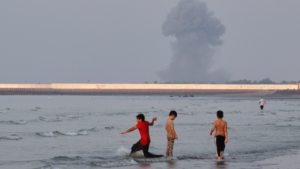
A scene of stark contrast on the Iranian coastline: three young boys play in the shallow waves of the Strait of Hormuz off Bandar Abbas, Iran, as a monumental plume of dark grey smoke from an explosion rises over a breakwater. This powerful juxtaposition of childhood innocence and conflict was captured on Monday, July 13, 2026. (Photo: Razieh Poudat/ISNA via AP)
From freedom of navigation to competing protection regimes
The Strait of Hormuz has traditionally operated as an international passage rather than the property of a single power. Iran and Oman border the narrow waterway, but international maritime practice recognises a right of transit for ships travelling between the Persian Gulf and the open sea.
Neither Iran nor the United States has ratified the United Nations Convention on the Law of the Sea. Legal specialists nevertheless generally regard the principle of transit passage through international straits as customary law binding on all states.
Iran has argued that the June agreement allowed it to administer traffic temporarily, provided it did not impose charges during the initial 60-day period. Tehran subsequently required ships to register with a newly established authority and demanded that they use a route close to the Iranian coast.
Washington disputed that interpretation and supported a southern passage near Oman. Iran has been accused of attacking ships using that route, while Tehran says American activity there violated the interim arrangement.
Trump’s toll proposal does not restore the previous principle of unrestricted passage. It mirrors, in a substantially more expensive form, the Iranian argument that whichever power supplies—or compels—security may demand payment.
The International Maritime Organization said there was no legal basis for mandatory tolls imposed simply for travelling through an international strait. Although states may charge proportionate fees for specific services, such as pilotage, that is different from taking a percentage of a vessel’s cargo in exchange for military protection.
The distinction matters. A navigational service is governed by identifiable costs and rules. A protection payment imposed by a military power resembles a levy on international commerce, with no clear mechanism for accountability, dispute resolution or protection against arbitrary increases.
The Trump administration has not explained how the proposed 20% payment would be calculated, collected or enforced. It has not identified the statutory or international legal authority on which the system would rest. Nor has it clarified what protection a paying ship would receive if it were subsequently attacked.
Until those questions are answered, the proposal remains a presidential declaration rather than a defined regulatory system.
The cost is not confined to oil-importing powers
The most visible market reaction has been in energy prices. Benchmark Brent crude rose above $84 a barrel in early Tuesday trading, according to AP, reaching a one-month high while remaining below the levels recorded during the most intense phase of the conflict.
The consequences, however, are distributed unevenly.
Higher shipping, insurance and energy costs are first absorbed by companies and governments. They eventually reach households through transport fares, electricity bills, food prices and reduced public spending.
UN Trade and Development estimates that a sustained 50% increase in refined-oil prices could add more than $20 billion annually to the import bills of vulnerable economies. Nearly one billion people live in the 75 least-developed and small-island economies examined by the agency, 65 of which are net oil importers.
The disruption also affects fertiliser, sulphur and liquefied-natural-gas shipments. The UN Food and Agriculture Organization has warned that higher energy and agricultural-input costs are already placing pressure on food systems, particularly in import-dependent countries where inflation rapidly reduces household purchasing power.
This is the conflict’s less visible geography. A missile fired near Oman may eventually appear as a higher food bill in an indebted African country, a more expensive electricity subsidy in South Asia or a further reduction in the purchasing power of a low-income household far from the Gulf.
Seafarers carry the most immediate civilian risk. The IMO estimates that approximately 20,000 seafarers, port workers and offshore personnel have been affected by instability in the region. Its evacuation framework had moved 136 vessels and about 2,900 seafarers by late June, while attempting to preserve the legal principle of free passage.
The death aboard the Mombasa gives that wider disruption an identifiable human cost. The casualty was not a senior official or military commander, but an Indian mariner working on a commercial vessel.
Gulf states face narrowing choices
Iran’s attacks on Bahrain, Jordan and UAE-linked shipping demonstrate the risks facing states that host American forces but have limited control over Washington’s decisions.
For Tehran, striking these countries increases the cost of supporting US operations. For the Gulf states, however, retaliation could expand a confrontation in which their ports, airports, energy installations and expatriate populations would be exposed.
The UAE’s warning that it may respond is therefore more than a bilateral exchange with Iran. It reflects the strategic dilemma of smaller and middle powers positioned between an American security structure and an Iranian capacity for asymmetric retaliation.
The result is a regional system in which formally sovereign states risk becoming operational terrain for decisions made principally in Washington and Tehran.
A narrower route away from escalation
The immediate options are limited, but they are not absent.
The June arrangement already contains the basic components of a possible de-escalation: a ceasefire, toll-free passage, Iranian commitments to facilitate shipping and talks with Oman over the future administration of the strait. Its failure lies less in the absence of a framework than in competing interpretations, weak verification and the rapid return to military enforcement.
A workable revised mechanism would require a clearly mapped maritime lane, independent monitoring, advance notification of vessel movements and a prohibition on both Iranian and American compulsory tolls. Oman, which shares responsibility for the strait’s traffic-separation system, remains the most credible regional intermediary.
The existing UN-led task force and IMO evacuation framework could provide the institutional foundation. A reinforced arrangement could include maritime observers, a joint incident-reporting centre and published procedures for investigating attacks or alleged violations before retaliation occurs.
Any fee would need to correspond to a specific, voluntary service and be approved through a multilateral maritime framework—not imposed as the price of avoiding attack.
United Nations Secretary-General António Guterres has warned that a return to full-scale hostilities would have catastrophic consequences for the region and international security. That warning now carries practical urgency.
Freedom of navigation cannot be defended coherently by replacing one coercive gatekeeper with another. Iran’s attacks on civilian shipping and the proposed American cargo levy arise from different military positions, but both subordinate an international waterway to unilateral power.
The central question is therefore no longer simply who controls Hormuz.
It is whether the international community still possesses the institutions—and the political will—to prevent control of a global public passage from becoming a commodity sold under the shadow of missiles.